Preferred Supplier Programs and What Advisors Actually Receive

Preferred supplier programs are the economic backbone of the travel advisor model. Advisors receive negotiated earning opportunities, client benefits and supplier support that would be hard to build alone. The business gains more when bookings that fit the client stay with preferred partners, because sales volume, knowledge of the products and ties with suppliers help each other grow.
What preferred supplier programs actually are and what makes them different from ordinary supplier relationships
A preferred supplier program is a formal, negotiated relationship between a host agency or consortium and selected travel suppliers. Those suppliers can be tour operators, cruise lines, airlines, hotels and destination management companies. Access alone does not make a supplier preferred. An ordinary supplier relationship lets an advisor sell a product, while a preferred agreement sets terms for a deeper commercial relationship.
The host commits to sales volume and passenger targets, and the supplier commits to closer collaboration in return. That collaboration can include higher commission opportunities, performance bonuses known as overrides, training, direct supplier support and service advantages for clients. These are negotiated benefits. Their value depends on what the agreement provides and how an advisor can use it.
Signature Travel Network’s supplier program shows how structured this relationship can be. Its terms include targeted distribution, marketing commitments with minimums, management fees for all sales with minimums, sales reporting, performance incentives and training access. This is not a casual vendor arrangement. The supplier gains a defined route to advisors and their clients, while the network creates opportunities its members can use. That helps explain why two advisors who can book the same supplier may earn different amounts and get different support for the sale.
How host agency and consortium membership translates preferred supplier contracts into higher commission tiers for individual advisors
The most direct benefit is access to higher supplier commission tiers. A host pools the sales of all its advisors, while a consortium pools the volume of the agencies that belong to it. The leverage comes from the whole network. An affiliated advisor can therefore access terms negotiated on a much larger base of business than their own.
Nexion advisor Mike Plumton describes receiving “commission levels and promotions that would be very difficult to reach as a single advisor”. Another Nexion advisor reports access to commissions in the 15% range across a wide range of partners. Actual terms vary by host, supplier and sales tier, so the percentage describes what one advisor could access within a particular host relationship.
KHM Travel Group states that pooled sales across its entire advisor base generate the supplier commission rates available to individual advisors from day one of membership. However, the supplier’s rate and the advisor’s own commission split are separate parts of the calculation. KHM’s advisor split starts at a base rate and rises only after the advisor reaches a set threshold in paid commissions within the calendar year. Those terms need to be understood separately. A strong supplier rate does not, on its own, tell an advisor how much of the commission they retain.
This also answers a common objection about preferred suppliers narrowing client choice. When several partners that fit the client offer strong commission terms, the advisor has less reason to recommend the one that pays more. The Nexion advisor’s account illustrates that possibility. Still, every preferred supplier will not be right for every client.
Override structures and why booking concentration compounds earnings over time
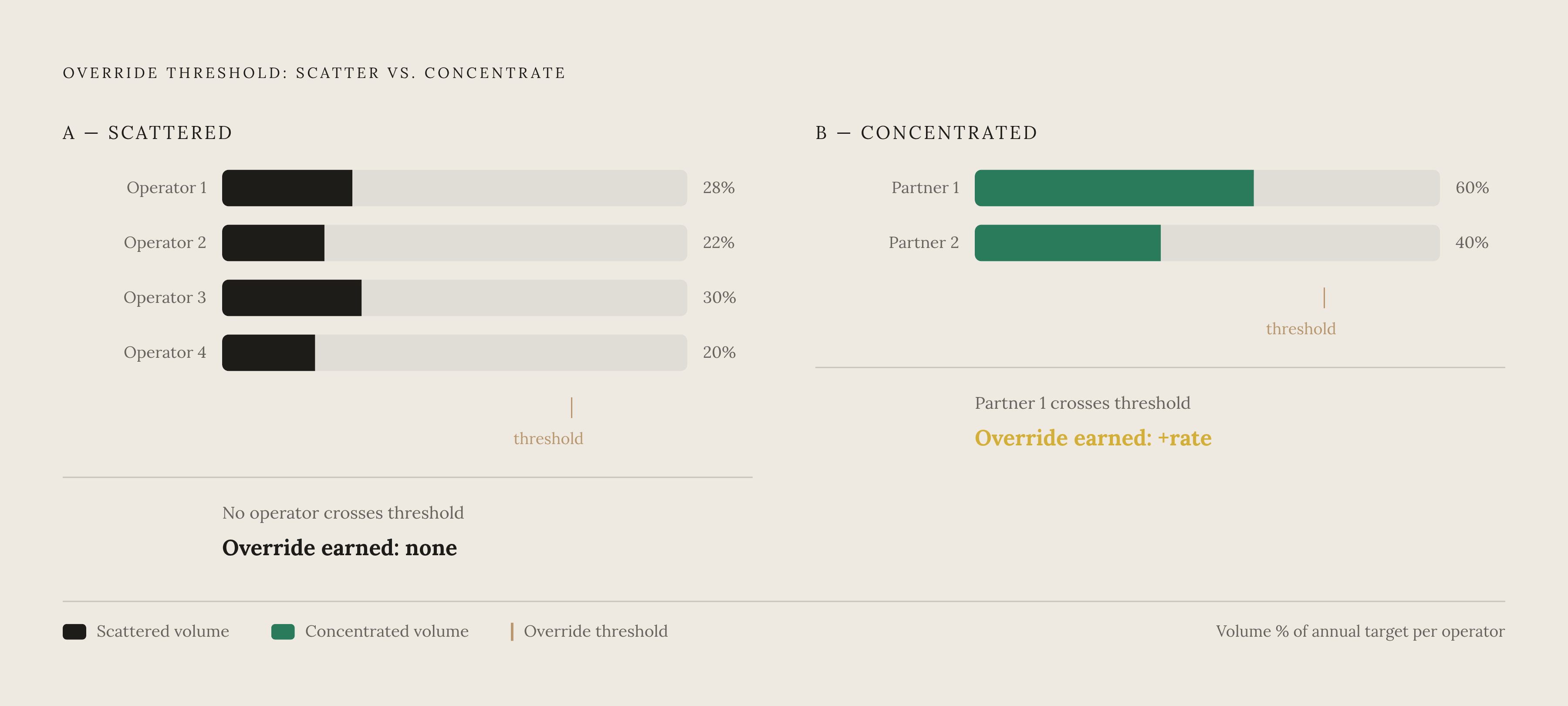
Overrides add a second layer to the commission calculation. They are commission bonuses triggered when an advisor or host reaches a supplier’s volume threshold. Unlike access to a negotiated base rate, an override depends on enough qualifying business accumulating with that partner. Scattered sales can leave that opportunity unused. The same overall workload can therefore produce different earnings depending on where suitable bookings land.
To make the logic concrete, consider escorted tour bookings spread across four operators. If none receives enough volume to reach its threshold, those bookings generate no override with any of them. Concentrating the same suitable business with one or two preferred partners can instead move sales past a threshold that unlocks a higher rate. Access to that higher rate depends on the contract terms. There is no universal override ladder, and bonus potential should not be confused with a guaranteed payment.
Concentration is a strategy that must preserve client fit. Where preferred partners offer the right experience, keeping bookings with them gives sales volume a chance to accumulate rather than continually starting small with another operator. As an advisor’s preferred-supplier business grows, it can move through override tiers. The host’s aggregate volume grows as well. That strengthens the host’s position when negotiating base terms at the next contract cycle, creating the self-reinforcing effect behind the strategy.
Changing hosts can interrupt that accumulation. A new host may have a different preferred roster, so the advisor may have to build up sales volume again before they can earn overrides. That is a real transition cost, even if it is less visible than a commission split. Advisors should weigh that transition cost when considering a move.
The host commits to sales volume and passenger targets, and the supplier commits to closer collaboration in return.
Client-facing amenities that preferred status unlocks and that advisors cannot replicate without it
Preferred status also changes what the client receives. Some benefits are unavailable through direct bookings or non-preferred channels, giving the advisor a concrete answer to a traveler who could otherwise book online. An advisor may be able to sell the same hotel without preferred status but lack the ability to attach the program’s complimentary privileges.
Hotel brand programs make this especially clear. Four Seasons Preferred Partner, Belmond Bellini, Dorchester Diamond Club, Rosewood Elite, Marriott STARS and Luminous, and Mandarin Oriental Fan Club operate parallel to larger consortia such as Virtuoso. Brand-program accreditation and consortium membership are separate credentials. Some hosts bundle access to both, giving affiliated advisors a route to benefits they would otherwise have to seek individually.
Four Seasons Preferred Partner is invitation-only. Clients cannot obtain its complimentary privileges simply by booking the same hotel online unassisted, at any price. There is an important distinction for existing reservations, though. A Preferred Partner advisor can attach benefits retroactively to a reservation already made directly with Four Seasons.
For the client, an included upgrade or credit can make the advisor’s offer different without adding an extra charge for that benefit. Delivering it costs the advisor nothing extra, but it depends on the relevant preferred access. The offer still depends on the terms of that program. An amenity available through one hotel program is not evidence that another provides the same upgrade or credit.
Training, FAM trips, and BDM relationships as the non-financial benefits that make an advisor more effective over time
The less visible returns build the advisor’s ability to sell well and respond when a trip goes wrong. Training develops product knowledge, familiarization trips known as FAM trips deepen familiarity, and relationships with business development managers, or BDMs, create a direct supplier contact. Preferred status opens the door, but an advisor has to use that access to develop expertise and supplier goodwill.
Signature offers preferred suppliers year-round opportunities to train advisors through intranet postings, webinars and meetings. It also gives suppliers an exclusive invitation to the annual Signature Travel Conference to train and connect with advisors and agency owners. The commercial logic runs in both directions. Suppliers invest in knowledge because informed advisors are better positioned to sell their products, while advisors gain more than a brochure-level understanding of what they recommend.
KHM identifies FAM trips as opportunities offered in partnership with preferred suppliers because of its supplier relationships. It also lists invitations to private events, incentive contests and offers of bonus commission as benefits of working with preferred suppliers. An advisor who has attended two supplier trainings, taken a FAM trip and had multiple calls with a BDM is better positioned to sell that product than one who has only read the brochure.
A direct BDM contact at a cruise line gives an advisor a faster escalation path if a cabin is double-booked or an itinerary changes at departure. It provides a route beyond the general booking channel when a client needs flexibility, an exception or help with a disrupted trip, though the requested outcome remains uncertain. For advisors new to a host, the lesson is to learn the preferred roster and invest in those relationships, even when that means adjusting established supplier habits.
Why the host agency's own preferred program infrastructure matters when an advisor is choosing where to affiliate
Because preferred agreements are negotiated above the individual advisor level, host selection directly shapes earning potential and supplier access. Affiliations can be compared on the commission terms, override opportunities, client benefits, training and direct support they make available. A preferred program has limited practical value if its strongest relationships do not fit the business an advisor serves.
Travel Leaders Network illustrates the breadth of infrastructure an affiliation can provide. Its programs include SELECT Hotels & Resorts, Distinctive Voyages, Amenity Departure Dates and Culinary Collection, while its tools include SNAP, Cruise Complete, Agent Universe and Agent Profiler. Members can use these programs and tools without having to build everything themselves. The network added 90 agencies in 2026, showing demand for the preferred supplier relationships, technology and marketing resources that a network of this size can offer.
The value can extend well beyond a booking cycle. Kira Gartner, owner of Blue Sky Destinations and a Nexion advisor, has stayed with her host for 18 years because of the support and empowerment it provides. Plumton likewise says he had supplier access and credibility from day one that would have taken years to build on his own. A move can mean rebuilding BDM relationships as well as adjusting to new suppliers and override terms. Advisors should choose carefully and leave a host that is a poor fit.
Advisors still have to manage bookings, commission status, client communications and itinerary building across multiple partners, and that administration limits the number of clients they can serve well. Gartner says her host handles back-office accounting, commission matching and tax documents, freeing time for marketing, sales and client service. That support turns access into usable capacity. Evaluating an affiliation therefore includes assessing which tools and services help an advisor put the negotiated benefits to work.
An advisor-focused AI workspace belongs in that discussion as a concrete example of the next layer of support alongside preferred agreements. The relevant workflow runs from a client brief to a bookable itinerary, then through booking and commission tracking. Advisors can test whether a workspace cuts the work at each step and connects with the systems they already use. No specific consortium integration is established here. For advisors concentrating business with preferred partners, commission-status tracking and help identifying booking opportunities are especially relevant capabilities to assess.
Internova Travel Group, the network’s parent company, is exploring how AI can support advisors, streamline workflows and improve travel planning.
Sources
- Travel Leaders Network Adds 90 Agencies So Far in 2026, Representing $130 Million in Sales - Internova
Provided details on Travel Leaders Network's programs, tools, and the 90 agencies added in 2026 used in the section on host agency infrastructure.
- Join Signature's Preferred Partner Program
Provided the specific terms of Signature Travel Network's preferred supplier program, including marketing commitments, management fees, sales reporting, and training access.
- Travel Partners
Provided information on KHM Travel Group's pooled commission model, advisor split structure, FAM trips, and other preferred supplier benefits.
- Why More Independent Travel Advisors Are Turning to Host Agency Support Models - Nexion Travel
Provided advisor quotes on commission levels, supplier credibility from day one, and long-term host loyalty used across multiple sections.