Cruise Line Commission Structures for Independent Advisors
Hidden deductions and tier structures shape cruise commissions far more than the headline rate.
Cruise line commission structures for independent advisors determine more than the percentage earned on a cabin sale. The real earnings depend on what that percentage applies to, which tier applies, what the host keeps, and when payment arrives. Advisors who understand those layers can make deliberate choices about revenue instead of discovering the gaps after the work is done.
Why a single commission percentage tells an independent advisor almost nothing about real earnings
A client pays a round fare, and the advisor applies the quoted commission rate to the total. The expected earnings look clear enough. But when the check arrives weeks after sailing, it is meaningfully smaller than expected. The mistake was treating the client’s payment as the amount on which the advisor gets paid.
That gap has several parts, including the commissionable base, tier status, host split, ancillary revenue, and payment timing. Some leave the advisor with less money, while others can pay more than the cabin commission alone. Timing then separates earnings on paper from money available to spend. The headline percentage cannot explain those differences because it describes only one step in the calculation.
What the commissionable base actually is, and what gets stripped out before the percentage applies
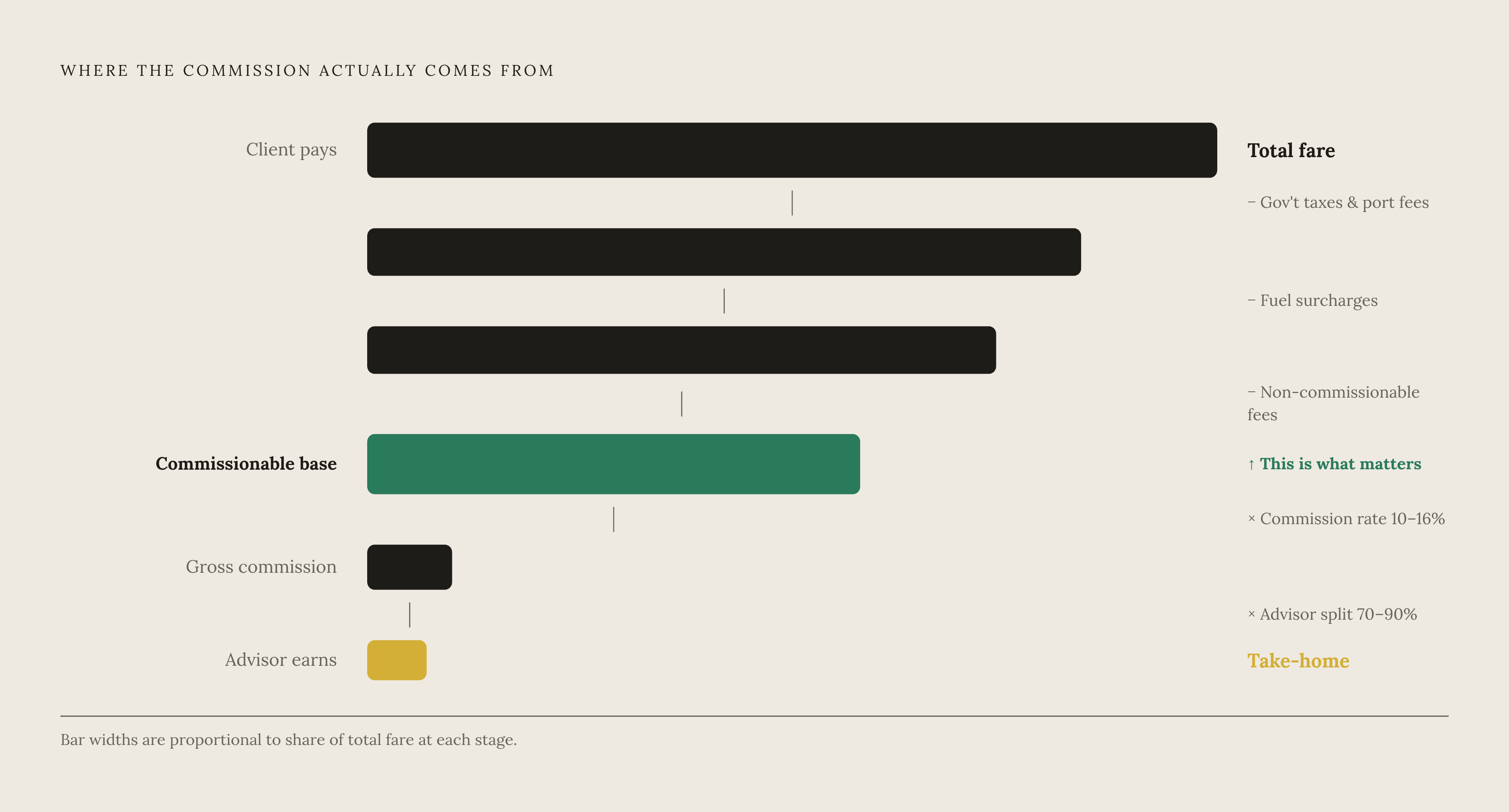
The commissionable base is the part of the cruise price that earns commission. To work through a simple booking, start with the client’s total payment and subtract government taxes and port fees. Next, subtract any separately charged fuel surcharge and any operational costs classified as non-commissionable fees, or NCFs. What remains is the commissionable fare, and only then does the percentage apply. These deductions are standard industry structure.
Cabin fare generally counts across standard cabins, suites, guarantee bookings, and published promotional fares. Certain bundled extras also count when the cruise line folds them into the commissionable fare. The distinction is between money the client spends and money the supplier treats as eligible for commission. Government taxes and port fees remain outside that base, while the treatment of other components varies by line. As a result, bookings with identical total prices can generate different commissions even at the same rate.
A fare with fewer deductions leaves more money exposed to the rate. Conversely, a larger NCF load shrinks the amount that earns anything at all.
How Norwegian Cruise Line's 2026 NCF elimination changes the commissionable base calculation
Norwegian Cruise Line’s 2026 NCF elimination shows how much can change without a rate increase. For sailings departing on or after May 1, 2026, its permanent policy makes the entire cruise fare commissionable, excluding only mandatory government taxes and port fees. The policy applies to bookings made from December 26, 2025 onward across its global sailings. NCL’s subsequent clarification put qualifying bookings at 99%, so the policy should not be read as applying without exception.
The larger base includes the full cruise fare for all cabin categories and the operational costs that were once classified as NCFs. It also includes the Free at Sea Plus upgrade, which was re-introduced with the change and made commissionable from launch. Taxes and port fees are still separate from the operational NCFs that were removed.
For a qualifying booking, the same percentage now applies to more of the quoted fare. That raises gross commission even if the advisor stays in the same tier. NCL links the change to its “Partners First” ethos, positioning it as a permanent competitive move. The commissionable base is a supplier policy that can change.
Base commission rates across cruise line segments, and why the percentage alone does not predict earnings
Base rates broadly rise from mass-market lines through premium to luxury products, but the pattern is not a complete earnings forecast. The base rate at both Carnival Cruise Line and Royal Caribbean International is 10%. Lindblad Expeditions has a standard 10% base, with up to 12% for consortia or preferred agents. Its premium-priced expedition itineraries can generate high absolute commission even where the percentage overlaps with mass-market rates. Booking value matters as much as the segment label.
A luxury fare paying 16% and including air, excursions, and beverages within the commissionable amount can produce more commission than a stripped-down mass-market fare paying 10%. That can hold even when the client’s out-of-pocket cost is similar. The difference comes from both a higher rate and a larger share of spending that earns commission.
Still, inclusions depend on the fare. Regent Seven Seas has a standard All-Inclusive Cruise Fare without flights and an Ultimate All-Inclusive Fare that adds round-trip flights and transfers. A higher-priced or more inclusive product is therefore not automatically a reason to favor it. The useful comparison is the actual commissionable value of the booking being considered.
How tiered commission structures work, and why reaching the next threshold matters more than it appears
Base rates are the starting point, and tier structures pay higher rates as production grows. Cruise lines may measure that production by the number of passengers booked each year or the total value of commissionable sales. When qualification is based on revenue, higher-value or longer itineraries can bring an advisor closer to a threshold with fewer bookings. At Princess Cruises, advisors can qualify through either passenger count or revenue, and Platinum pays 13%. The route to a tier therefore matters as much as the rate attached to it.
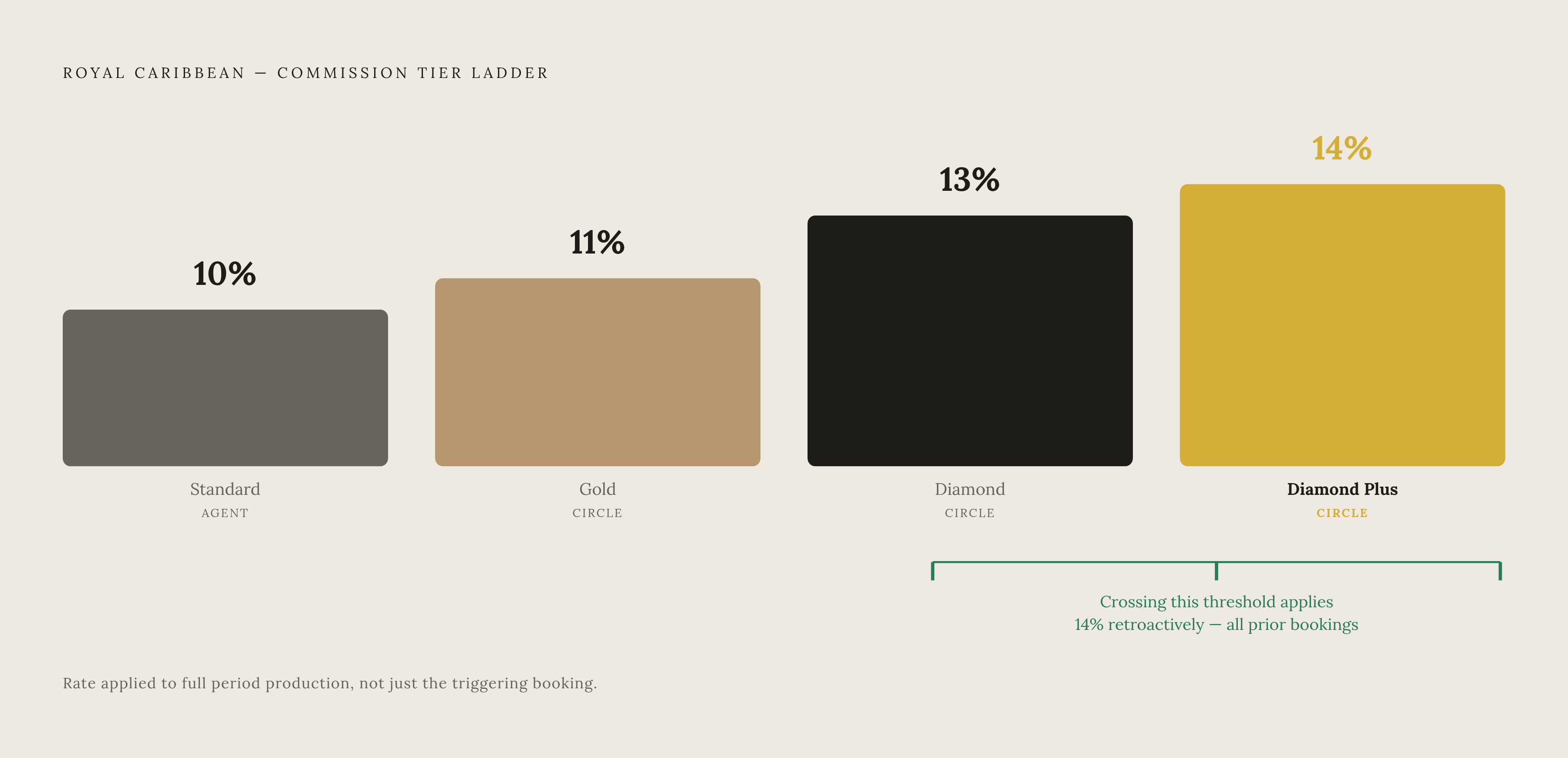
Royal Caribbean’s structure illustrates the progression. The rate is 10% for Standard Agent, 11% for Gold Circle, 13% for Diamond Circle, and 14% for Diamond Plus. Those steps become especially valuable where a higher rate applies retroactively across the qualifying period. That treatment must be distinguished from a rate that applies only to incremental bookings.
Consider an advisor just below a threshold who places one more group booking and crosses it. If the line applies the new rate to all bookings in that tier period, the group lifts earnings on earlier production as well as on itself. Its value is therefore greater than the commission attached to the marginal sale.
That gap has several parts, including the commissionable base, tier status, host split, ancillary revenue, and payment timing.
What host agency splits and consortium membership actually do to the take-home number
The cruise line’s gross commission is usually not the independent advisor’s take-home amount. A host agency retains a share in exchange for credentials, technology, and supplier access. Advisors who are starting out often have a 70/30 split and keep 70%. Reaching set production milestones may raise that to 80/20, and senior advisors or those who sell more may get 85/15 or 90/10.
Some hosts instead charge a flat monthly fee and let advisors retain 100% of commissions. That works better for advisors who sell enough to pass the break-even point. But minimizing the host’s share is not the same as maximizing take-home earnings. The gross commission available through the relationship also matters.
Consortia such as Virtuoso, Signature Travel Network, Travel Leaders Network, and Ensemble combine the production of their member agencies to negotiate higher tiers with suppliers. Membership typically carries annual fees and brings preferred supplier relationships and marketing support as well as elevated rates. A host with consortium access can therefore give an advisor a rate their personal production would not qualify for alone. The split is a trade-off between the share retained and the earnings structure that becomes available.
Group bookings and ancillary revenue streams that move total earnings beyond the base fare commission
A well-structured booking can earn more than the published cabin commission suggests. Group benefits add value that does not always appear in the rate schedule. Carnival Cruise Line’s group threshold is 8 cabins, while its Tour Conductor Credit provides 1 complimentary berth for every 15 full-fare passengers. Complimentary inventory that can be sold adds proceeds beyond the stated commission percentage.
Ancillary products extend the earnings base in a different way. Royal Caribbean, Celebrity, Princess, and Holland America pay commission on shore excursions when they are booked through agent channels before sailing. That adds revenue per passenger, particularly on longer itineraries with more excursion spending. Travel insurance and pre-cruise hotels can also carry commissionable value. The cabin sale is therefore often the floor of a booking’s earnings.
Planning fees belong in that picture as professional revenue in their own right. Charged directly to clients, they pay for the advisor’s planning work rather than depending on a supplier’s fare calculation. They are separate from supplier commission and are not subject to NCF deductions, tier requirements, or host splits. They are an increasingly standard way to charge for genuine value.
Commission timing and cash flow — the structural risk that earnings projections routinely ignore
Even a strong commission calculation says nothing about when the money reaches the bank. Cruise commission does not arrive when the booking is made, and payment schedules differ by line. Final payment is usually due about 90–120 days before the ship departs. Carnival and Azamara are among the lines that pay commission after final payment, while other lines pay 30–60 days after the sail date.
A sailing booked 12 months ahead may not generate commission income for 9 months or longer. That can put pressure on an advisor’s first year even when projected annual earnings look healthy. Once a pipeline is established, staggered sailings can turn that delay into a more regular stream of receipts. Upfront planning fees can help smooth the gap because they arrive at booking rather than following the supplier’s deferred schedule. Managing the delay requires earnings forecasts to distinguish expected commission from available cash.
How AI-powered tools are changing the speed and accuracy with which advisors can model and manage commission across a complex booking
These calculations get harder when an advisor works across several lines and many bookings. An advisor has to track the commissionable base, tier progress, group thresholds, ancillary products, and expected payment dates at the same time. A static rate guide captures only part of that picture. Shifting NCF policies, dynamic ancillary pricing, and annual tier resets can make an older assumption unreliable. Keeping up with those changes takes time when advisors do all the calculations by hand.
Purpose-built tools and AI-assisted workflows help advisors get more done by using real-time data and responding faster to changes. Their value is making the relevant moving parts easier to model and manage across a complex booking. Accuracy still depends on the applicable fare, supplier policy, and host terms.
The practical moves that separate advisors who maximize commission from those who leave earnings on the table
Start by tracking tier position with each line throughout the qualification period. When passenger count and revenue offer separate ways to qualify, check which threshold is closer before deciding where to place the next group booking or family inquiry. Then compare the commissionable base rather than assuming a higher quoted percentage pays more. More inclusive fares, including those offered by Oceania and Regent, can place more client spending inside that base. NCL’s 2026 change shows why those comparisons need to use the policy in place now.
Build group production deliberately, because its benefits can alter the effective return on the whole booking. Celebrity and Princess pay higher percentage rates for groups, and Carnival adds value through complimentary inventory. Make shore excursions, travel insurance, and pre-cruise hotels part of the booking process. Confirm each ancillary product’s commission status. This makes the full proposal the unit of earnings planning.
Finally, plan the calendar around payment timing. Upfront planning fees and a mix of early-booked groups and near-term individual sailings can help bridge the wait for supplier commission. Advisors who understand the structure are not at its mercy. The commission system rewards those who engage with it deliberately.